



Child Protection Concept of Kita Zauberwald e.V.
Status: April 2022
Foreword
Kita Zauberwald e. V. is a parent initiative founded in 2008.
It is characterized by grassroots democratic structures.
Kita Zauberwald e.V. is represented by the chairpersons of the association
Mr. Marco Weber,
Ms. Jenny Günther, and Ms. Nicole Schmidt.
The initiative is characterized by a spirit of joint design and responsibility for all concerns.
With the entry into force of the Federal Child Protection Act (BKiSChG), a lot of responsibility regarding child protection is transferred to the team, the voluntary board, and the parents. They must ensure that:
- the rights of children are preserved,
- children are protected from boundary-violating behavior within the facility,
- children experience protection in case of child endangerment in the family and environment,
- suitable procedures for participation are developed, further developed, and applied,
- there is an opportunity for complaints in personal matters for all involved,
- and procedures for protection in case of suspected child endangerment are established and applied.
All these requirements are considered and established in this protection concept. The concept is known to all involved and is presented to new members, parents, and employees.
The present concept was developed jointly over a long period with the participation of the team, the children, the board, and parent representatives and is continuously reviewed, updated, and further developed.
It serves the protection and well-being of the children entrusted to us and the employees in the facility.
The aim of the concept is the prevention of assaults, a sexualized atmosphere, or discrimination of any kind.
1 Introduction/Guiding Principle
We, the employees of Kita Zauberwald e.V., are aware that in our daily work we bear a high responsibility for the well-being and protection of the children entrusted to us.
Our daycare center should be a safe place for the children – a place they like to go to, where they experience trustworthy adults, experience themselves in a community of children, and learn something new every day.
Especially the young children in the U3 group rely on special protection and support from empathetic and well-trained personnel. Through training, further education, observations, and professional exchange with each other, we have trained and further developed our sensitivity. Thus, in many cases, we succeed in finding out how the individual child is feeling, even if they cannot yet express themselves linguistically for the most part.
The relationship between children and adults is inherently unequal, as adults bear responsibility for the children at all times, but children never bear responsibility for the adults. Therefore: Children need responsible adults so that their rights are realized.
Our claim is to implement our pedagogical concept for the well-being of the child and to create a pleasant atmosphere for all involved (children, employees, parents). In this context, it is our task to protect the children from all forms of violence, sexual abuse, abuse of power, as well as physical and psychological violence – both internally and externally.
Furthermore, we see it as our task to carry out and further develop preventive measures for any forms of violence. This includes our special concern to establish an open communication culture in our facility so that our employees are empowered to address even unpleasant and sensitive topics transparently and openly. Because we are aware that the probability of recognizing child endangerment at an early stage increases through close exchange with the parents. Therefore, we place another focus on cooperative partnership with parents.
By keeping an eye on the child together and exchanging information about it, preventive child protection is made possible. We always try to keep in focus that parents are experts on their children, as their children communicate differently to them in most cases than to the employees in the daycare center.
2 Legal Basis
The protection of child welfare (mental, spiritual, and physical integrity) is an essential part of our daily pedagogical work and it is our task to secure child welfare and protect children from dangers.
Our child protection concept is based on the following legal foundations:
- Federal Child Protection Act (Bundeskinderschutzgesetz) of January 1, 2012 ("Protecting the well-being of children and promoting their physical, mental, and spiritual development")
- State Child Protection Act NRW (Act on the protection of child welfare and the improvement of the protection of children and adolescents in NRW)
- § 8a SGB VIII (Protection mandate in case of child endangerment)
- § 72a SGB VIII (Exclusion from activity of persons with a criminal record, extended certificate of good conduct)
- UN Convention on the Rights of the Child (Right to equal treatment, priority of child welfare, right to personal development)
- German Civil Code (BGB) § 1631 Para. 2 (Right to non-violent upbringing)
3 Spatial Structures
The facility Kita Zauberwald e.V. offers two groups – a U3 (under 3) and an Ü3 (over 3) group.
On the ground floor, each group has a group room and an adjoining room. The cloakrooms are in the hallway. The toilet rooms can be reached from the cloakroom of the Ü3 group. The kitchen and a room for cleaning utensils are also located on the ground floor.
- The front door can only be entered via a buzzer function. This function is only switched on during drop-off and pick-up times.
- Visitors, craftsmen, representatives, etc., sign in a visitor list.
- The group rooms are designed and furnished to be easily visible.
- Glass doors offer a view into all rooms.
- The elevated levels (lofts) are visible through small viewing windows.
- Retreat areas (caves, doll corner) are visible at all times.
- The kitchen is visible through a glass door.
- The room for the cleaning staff is generally locked during regular operations. The key is kept inaccessible to children.
- A niche under the stairs is illuminated by a motion detector.
On the upper floor, the children's sleeping rooms are on the right side. The changing room can be reached via the small hallway to the emergency exit stairs. On the left side are the staff toilet, the staff room, the management office, and the large movement room.
- The movement room is visible at all times through the glass door.
- The doors in the sleeping rooms will now be equipped with small viewing windows promptly.
- The doors in the staff room and office will also be equipped with small viewing windows in such a way that the privacy of the employees is preserved.
- Since the changing area in the changing room is not visible from the hallway, the door there always remains open.
The two attics of the building can only be reached via a retractable staircase and are thus not accessible to children. Locking the retractable staircase from the inside is not possible, so no person can stay there unnoticed.
In the basement of the building, there is a washroom, a storage room, and two rooms with pedagogical and handicraft materials.
The basement is only to be entered by specialists with children in exceptional cases, such as exchanging play material or assembling food for a cooking offer.
In these cases, a pedagogical specialist can enter the basement with at least three children. The colleagues of the group must be informed in advance.
Outdoor Area:
Kita Zauberwald e.V. has two outdoor areas.
The first outdoor area borders directly on the building and can be reached from both groups through a patio door.
This area is clearly structured. Due to the rectangular shape, the garden is also easy to overlook from the groups. The fence is provided with privacy screen elements so that the area is not visible from the outside. The area has an entrance and exit. The access is open during pick-up times and can only be opened from the outside by a door handle. The gate is visible so that unauthorized persons cannot enter the area easily and the children cannot leave the area unnoticed.
The digging corner next to the Ü-3 group room is partly only visible from the inside through the windows. It is planned to attach a mirror to the corner so that the corner is also better visible from the garden. The fence in the digging corner will be raised so that children cannot be lifted over the fence. The fence behind the material shed will be raised for the same reason.
The second area is located 50 m further away from the building at the beginning of Kuhloweg.
The area is the property of the city of Bielefeld and was leased, fenced, and set up by the facility Kita Zauberwald e. V. The group of children is always accompanied and supervised by at least two employees. The area is not completely protected from view. Due to a rising footpath behind the area, it is too visible to pedestrians. The area is partly surrounded by shrubs and
bushes and thus offers a natural privacy screen. Since this circumstance is known to all employees, special attention is paid to unknown observers on this site.
4 Personnel Development
The board and the facility management of Kita Zauberwald e. V. are very intent on achieving an appropriate staff-to-child ratio. This ensures that sufficient personnel are always available for supervision and accompaniment, even during fringe hour care (early and late shifts).
Employees who are released due to pregnancy and parental leave are promptly replaced by new employees.
As of March 23, 2022, the guidelines for all areas of personnel development have been adapted to child protection.
4.1 Recruitment Process
In job advertisements, it will be pointed out in the future that child protection has a high priority in our facility and children's rights are given great attention.
4.2 Hiring Process
In job interviews, attention is drawn to the child protection concept and authorization for information from the last employer is requested. The applicant is presented with the Code of Conduct of Kita Zauberwald e. V., which will be part of the future employment contract.
4.3 Employment Contracts and Annexes
Child protection is anchored in the employment contracts as follows:
- Item 2 Extended certificate of good conduct
- Item 7 Confidentiality clause
- Item 8 Self-commitment to responsible handling and acting according to our protection concept.
- Annex: Self-commitment Code of Conduct of Kita Zauberwald e. V.
4.4 Onboarding
Onboarding takes place according to our onboarding concept.
The first week of work:
- Handover of concepts
- Handover of house rules
- Working through the protection concept and the Code of Conduct (ethical and professional attitude)
- Employee appraisals after the respective onboarding phases and as needed.
4.5 Employee Appraisals
Employee appraisals take place regularly once a year. Here, the pedagogical attitude and pedagogical action of the employee are also reflected. A copy of the written record is handed out.
4.6 Further Training
Employees are given the opportunity to participate in further training regularly, at least once a year.
In addition, team training sessions take place regularly. Here, the topic of child protection is deepened and refreshed so that the procedure is familiar to all employees. In the future, a child protection officer will be trained for each group.
5 Attitude – Child Protection in Pedagogical Work
It is known that sexual abuse takes place 52% in the family environment, 32% in institutions, 9% in the wider social environment, and 7% by strangers. From these figures, we as a daycare center derive that awareness of the topic is unavoidable; every 5th child is affected in some form and an attitude of mindfulness is required.
It is not about mistrusting everyone and everything or about "total control" – for us in Zauberwald, it is about building trust, creating opportunities for children to tell stories AND listening to them attentively.
We know: Abuse preferably takes place in an environment that
- - Makes detection unlikely, e.g., due to tabooing the topic.
- - Shows over-structuring (it is foreseeable when which child is alone where).
- - Shows no or hardly any structures (no one knows exactly when and where children are)
- - Conveys little sex education
- - Has no knowledge of help options.
Therefore, appropriate structures have been created in Kita Zauberwald e.V. under many aspects (e.g., settling in, complaint management, participation, work with parents) and established in the pedagogical concept, which guarantee freedom and protection at the same time.
In the following, many important aspects of child protection are anchored and compiled in our daily pedagogical work:
5.1 Age-Appropriate Sex Education
Already from the first year of kindergarten, the body parts are correctly named with the children in a playful way. This succeeds through circle games, gymnastics, dancing, looking at picture and hidden object books, or in individual contact e.g., when changing diapers.
The genitals are referred to as penis and vagina by all employees.
We convey to the children which actions are not okay, be it among themselves or in contact with adults.
The children are taught that touching, kisses, gestures, and expressions of tenderness must not originate from the staff and which types of physical contact are allowed.
The children are taught that they are allowed to say NO and what options they have if an employee or another person from the child's personal environment does not listen to STOP.
Guided role-plays and small performances are intended to strengthen the children's self-confidence and help them to take practical action (Little No, Big NO, STOP, Help).
Situational questions from the children are answered in an age-appropriate manner and the parents are informed about
the child's interest. Thus, further pedagogical intervention can take place in coordination and if necessary with the parents.
5.2 Pedagogical Work with the Body, Physical Boundaries, and Feelings
Within the framework of daily pedagogical work, the following topics on child protection are treated repeatedly over all kindergarten years:
- Projects and work on the perception and naming of one's own body
(e.g., "What are all body parts called" including genitals, creative representation and uniqueness of one's own body, gymnastics, dancing, tracing one's own body, face painting, dressing up)- How and where are my physical boundaries? ("My body belongs to me!")
How can I maintain these boundaries (little No, big No).
- How do I behave in situations that are unpleasant for me?
- What do I perceive as pleasant and what not and how can I express that?
We work on the program "Safe and Strong" by Ralf Schmitz with preschool children. It is intended to help them develop action strategies.
The self-assertion course "Bärenstark" by Sportbund Bielefeld is offered regularly for preschool children from 2022.
Perception, naming, and regulation of feelings (e.g., work with feeling cards, feeling magnet board, games on different emotions, regular discussion rounds about feelings and dealing with them). Through the use of Kamishibai cards, we give the children storytelling occasions and thus have the opportunity to learn about their views, wishes, and needs.
5.3 Proximity and Distance
Professional handling of children means maintaining the right relationship between proximity and distance.
- - Children are hugged in our daycare center, see the educator as a safe haven (Berlin Settling-in Model).
- - Comforting is always connected with the goal of bringing the child back into play.
- - Physical contact always originates from the child and is oriented towards their well-being.
- The educator shows professional behavior by recognizing when the child no longer needs close physical contact. The contact should be ended by the caregiver as soon as possible and not unnecessarily prolonged.
- - Kisses on the mouth or cheek exceed the professional proximity-distance relationship between caregiver and child. Therefore, children are not kissed by caregivers. The only exception here are kisses on the cheek of the caregiver initiated by the child - the team considers this a legitimate gesture of affection. In such a case, employees can allow or reject this gesture of affection according to individual sensitivities. Here, attention must be paid to equal treatment of all children.
- - The use of pet names is not permitted. Abbreviations or appendages to first names (e.g., Tomi) are considered legitimate by the team, provided it is accepted by the child.
5.4 Protection of Children's Privacy
The protection of privacy is very important to us. Our protective measures are regularly reviewed and reflected upon.
The implementation of protective measures takes place in the areas of diaper changing situation, going to the toilet, applying lotion, nudity, and doctor games. Swimming lessons, splashing, and the sleeping situation are described in detail in our sexual pedagogy concept.
The sexual pedagogy concept is part of this child protection concept.
Children are not filmed with private mobile phones or cameras. At events, parents are asked not to take photos or films of the children. Photos from the company tablet are never publicly presented or reproduced in any way.
6 Team Culture
The following measures are defined in our protection concept to reduce the probability of perpetrators entering our facility.
- Regarding abuse prevention, no employee rests in the confidence of the attention of others. Every employee practices the culture of mindfulness in all matters. Encroaching behavior is addressed and/or reported to the management.
- The hiring process follows the principles of personnel development
(see point 3).
Within the team, the topic of child protection and sexual abuse is always dealt with openly and professionally.
- All children from both groups know all employees and vice versa.
This is promoted through cross-group offers, joint care in early and late shifts, joint morning circles, joint excursions, and festivals. Above all, this is ensured by the greeting culture in our house:
Every employee visits every group for a morning greeting when starting work. - Job shadowing of employees for the purpose of observation, feedback, and mutual reflection is expressly desired.
- The facility generally maintains a culture of the "open door", provided it does not
violate the privacy of the children and the employees.
- Private contact with parental homes should not be maintained (babysitting services or similar).
- Parents are addressed formally ("Sie") in our house to ensure professional distance.
- In daily pedagogical work with the children, setting boundaries is essential
We deal with the children when it comes to negotiating and adhering to rules. However, this does not affect all areas of coexistence.
To ensure a regulated daily routine and friendly interaction, basic rules also apply which are non-negotiable. A behavior traffic light serves as a guide for our pedagogical employees for appropriate behavior in everyday life with children.
We have categorized the following attitudes and behaviors of employees into:
red – This behavior is not tolerated (and is associated with consequences)
yellow – This behavior is pedagogically critical and can occur depending on the situation in
everyday life, but must be reflected upon
green – This behavior represents desirable interaction (is pedagogically
compatible, even if the children do not always like it)
As a team, we are aware that everyone (specialist, parents) can act in the "yellow" area at times. Here it is important to address situations and reflect (together).
| RED |
|
|
|
| YELLOW |
|
|
|
| GREEN |
|
|
|
7 Participation
The participation of children, parents, and employees in a parent initiative needs rules for the type and limits of participation opportunities, awareness of the participation of all, and constant reflection on the different roles in the facility (child, team, parents, board).
Below are the participation opportunities and obligations of the individual groups, especially with regard to the topic of child protection:
7.1 Participation of Children
The participation of children is an important concern in our facility. The children have diverse opportunities for co-design and co-determination in our facility. These opportunities for lived participation are detailed in our Children's Rights Concept.
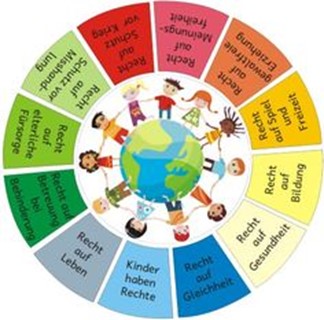
So that children can walk through life confidently and learn to maintain their boundaries, it is important that they are also aware of these rights. This is also a good basis for abuse prevention. The pedagogical team consciously integrates children's rights into daily pedagogical work. As an example, the most important rights and their protection in our facility are named here.
- Children have the right to non-violent upbringing
- Physical punishment or psychological abuse of power are strictly taboo in our facility (see also Code of Conduct (Annex to Employment Contract) and Team Culture).
- Children have the right to be involved in all decisions affecting them according to their age and maturity
- The children may choose their caregivers themselves.
- The children may decide which caregiver performs care activities (changing diapers, toilet accompaniment). Children may also reject offers from caregivers in this regard.
- The children are regularly asked for their opinion, needs, and
- concerns (morning circle, table situation, in daily work, in individual contact)
- The children may choose their play locations themselves. A location magnetic board (photos of the children can be hung in the respective room/location) serves the children and employees for orientation and protection. Thus, each child can also withdraw according to individual sensitivities.
- The children are included in the selection of project and offer topics.
- Children have the right to equality
The caregivers ensure not to favor or disadvantage any child. However, for our team, equality does not mean that all children are treated identically. The individuality of each child (temperament, developmental status, age) is perceived sensitively and taken into account by us.
Every child is treated with appreciation and tolerance equally. Established rules and freedoms apply to all children. A concept for the integration of children with disabilities is currently still in progress.
Children have the right to leisure, play, and recreation
In the daily routine of the facility, care is taken that:
- the range of pedagogical offers in the weekly schedule does not overburden the children.
- the children can decide for themselves whether and when they want to participate in guided
- offers or projects.
- sufficient time, space, and material for free play are available to the children
- time and space for retreat possibilities are available to the children
daily, after lunch, a rest phase is offered during which the children can sleep or rest.
Children have the right to the free development of their personality
The pedagogical caregivers perceive the children as individual personalities. Support is designed accordingly, especially the settling-in
of children in the U3 area, as well as the transition to the Ü3 group.
Children are not pushed into gender roles and are encouraged in the development of their own
interests and personality.
Living out childhood sexuality is not prevented but accepted and promoted (see sexual pedagogy concept).
7.2 Participation of Parents
Advance Information for Parents
Parents receive information on prevention measures, the child protection concept including the sexual pedagogy concept of Kita Zauberwald e.V. already at the "Info Evening for New Parents" and during the admission interview.
The protection concept is an annex and part of the care contract.
Parent Evenings
In the first half of the kindergarten year, a parent evening designed by employees takes place on the topics of abuse prevention, natural sexual development, children's rights, and their implementation in the facility.
Once a year, an additional parent evening led by external specialists (PRO Familia, Youth Welfare Office, medical counseling center, etc.) takes place for all parents and caregivers on the topic of Abuse Prevention or Childhood Sexuality.
Close Cooperation between Parents and Team on Many Levels
In the daily work of Kita Zauberwald e. V., there are many opportunities for exchange with parents, which can be used in addition to the joint educational partnership for the child for the purpose of building trust in child protection. There is a monthly open consultation hour, chat afternoons for parents with the participation of an employee, a written parent survey, joint excursions, joint festivals, and a team day with the participation of the parents' council.
Parent consultation days take place twice a year to exchange information on the child's developmental status. In addition to brief exchanges, a parent interview can be offered at any time if required. Parents can state in the care contract whether their children may be photographed or where these photos may be presented.
Participation at Provider Level
In KiTa Zauberwald e. V., every association member has the opportunity to bring in topics or vote on topics at regular general meetings. Therefore, we advise parents to have both parents become members to increase their co-determination opportunities. Parents have the opportunity to complain to the provider or ask for a conversation at any time.
The phone numbers of the association board members are posted in the entrance area of the daycare center.
Public Relations:
The child protection concept, the pedagogical concept, and the children's rights concepts can be found on our homepage www.kitazauberwald.info.
7.3 Participation of the Team
In the facility Kita Zauberwald e. V., there are several formats of team meetings in which, among other things, all concerns of child protection are discussed:
- once a day morning briefing (with one specialist per group)
- once a week preparation time for a group
- once a week large team meeting of all team members
Team meetings on the subject of child protection concept and children's rights take place regularly. This ensures that new employees get to know the concept in detail and the contents are present again to all employees. Thus, constant review, reflection, and adaptation of the concepts is guaranteed.
The concepts can be viewed by employees at any time. The folder is in the staff room and is always accessible.
At least once a year, training takes place, individually or in a team, on the topic of child protection. All employees of the facility participate in or help shape the parent evenings on the topic of child protection.
Once a year we invite a specialist speaker on the topic of child protection to the staff meeting. The manager Ms. Kaiphas and the deputy manager Ms. Dellinger are available to employees for a conversation at any time. Small and large decisions are always made in cooperation with the team. A solidary, participatory, and transparent team culture is very important to us in our facility.
8 Complaint Management
8.1 Complaints by Children
The team is aware that children's complaints are not always expressed directly. Often, however, complaints are expressed non-verbally through facial expressions, gestures, posture, aggression (hitting, biting, pushing, etc.). Therefore, our team continuously trains itself to filter out children's complaints from indirect statements or from the children's behavior and to take them seriously. Care is taken to give the children sufficient opportunities to talk (e.g., table conversations, in 1:1 situations, with hand puppets). Children need permission to complain. The educators signal to the children through their reaction that complaints are allowed and taken seriously. For this, the children must be able to recognize the connection between the complaint and the resulting consequence.
Through picture cards and diagrams, we show the children ways how and to whom they can complain in conflict situations with children and/or adults.
8.2 Complaints by Other Groups of Persons
In addition, there is a developed action model in Kita Zauberwald e. V. for problems and conflicts of various kinds and sources, which is presented below and posted in the daycare center accessible to all involved.
Here, in a first step, the principle of Kita Zauberwald e. V. is always followed: "We speak with each other and not about each other".
Only when direct contact between the conflict parties is not fruitful, the other instances are called in in the prescribed order.
Important: If parents or the team report incidents regarding the behavior of a team member (especially regarding child protection issues), there is a defined sequence of measures:
- Conversation with the management or deputy management, with protocol
- Calling in the experienced specialist (Paritätischer Service)
- Calling in the sponsorship/provider
Action model for problems and conflicts in Kita Zauberwald e. V.
Complaint Management Table| Who has a problem with whom? | comes to | if not resolved, then |
|---|---|---|
| 1. Parents with caregiver | relevant caregiver | Facility management or deputy facility management Parents' council, Sponsorship |
| 2. Caregiver with parents | relevant parents | Facility management or deputy facility management Sponsorship |
| 3. Parents with board member | relevant board member at full board |
Facility management or deputy facility management Sponsorship possibly Paritätischer Association or Youth Welfare Office |
| 4. Board with parents | relevant parents | Facility management or deputy facility management Sponsorship |
| 5. Board with caregiver | relevant caregiver | Facility management or deputy facility management Parents' council, Sponsorship |
| 6. Caregiver with board | relevant board member | relevant parents |
| 7. Parents with parents | relevant parents | Parents' council Facility management or deputy facility management Parents' council, Sponsorship |
| 8. Caregiver and other caregiver | relevant caregiver | Facility management or deputy facility management Sponsorship |
| 9. Team (caregiver) with facility management | Facility management | Deputy facility management Team meeting Supervision, Sponsorship |
| 10. Management with team (caregiver) | Team, relevant caregiver |
Team meeting Supervision Sponsorship |
9 Cooperation with External Specialist Consultancies
Below are all cooperation partners who work with Kita Zauberwald e. V. in various areas.
The list is continuously updated and supplemented.
9.1 Contacts
Experienced Specialist of the Paritätischer (NRW)/Child Protection Specialist
Claudia Meyer zu Westerhausen (Kita Wirbelwind, Westerfeldstraße) 0521 – 55 74 25 500
Anna Bolten (Kita Villa Wundervoll) 0521 – 92 01 53 20
Specialist Unit for Child Protection at the Youth Welfare Office Bielefeld for reports under §8a
Özlem Yanar: 0521 – 51 60 54
Melanie Uekötter: 0521 – 51 38 41
Claudia Hütker: 0521 – 51 36 63
Mail:
Website: www.bielefeld.de/de/biju/fki/
Specialist Counseling Child Care in the State Youth Welfare Office for reports under §47
Fax: 0251 – 59 16 58 0
Mail:
By post marked "Urgent!":
LWL- Landesjugendamt Westfalen Fachberatung Kindertagesbetreuung,
Warendorfer Str. 25, 48145 Münster
Specialist Counseling at the State Youth Welfare Office for the Youth Welfare Office District Bielefeld
Heidi Wachau: 0251 – 59 18 27 9
Mail:
Medical Counseling Center against Neglect and Abuse of Children e. V.
Tel.: 0521 – 13 08 13
Mail:
Website: https:/aerztliche –beratungsstelle-bielefeld.de
Pro familia Bielefeld e. V.
Tel.: 0521 – 12 40 73
Mail:
Website: https:/www.profamilia,de/angebote-vor-ort/nordrhein-westfalen/bielefeld
10 Procedures in Case of Suspected Child Endangerment
10.1 Procedure for Endangerment Outside the Facility
|
Conspicuous behavior is observed: |
|||
|
No endangerment |
Low endangerment |
Medium endangerment |
High endangerment |
|
Further intensive observation, possibly parent interview + inform team regarding ped. strategies for dealing with the abnormality |
Conversation with parents regarding risk assessment Proposals on possible assistance offers + further observations Information of the team and possibly the provider In case of lack of accessibility or no/insufficient use of assistance offers or lack of change in parental behavior Continue as with medium endangerment |
Information of the entire team (possibly provider) Involvement of an experienced specialist. Parent interview regarding risk assessment + assistance offers (possibly inquire at local Youth Welfare Office) |
Information of the entire team and the provider. Involvement of an experienced specialist (InsoFa), meetings regarding further procedure (parent interviews, strategies) Report to local Youth Welfare Office (by parents, in case of refusal by the facility) Is there an intensification of endangerment or cover-up when confronting parents? No parent interview Maintain contact with child, inform about further steps, convey and ensure safety. |
| Parent Interview | |||
| has taken place | was refused | ||
| Accessibility of parents | |||
| yes | no | ||
|
Further observation In case of change in parental behavior + reduction of indications Currently no further measures necessary, further observation. In case of no or insufficient use of assistance offers or lack of change in parental behavior Continue as with suspicion of high endangerment |
continue as with suspicion of high endangerment. | continue as with suspicion of high endangerment. | |
10.2 Procedure for Endangerment Inside the Facility
|
Who is Responsible |
Process Course |
||
|
Occurrence of boundary-violating behavior |
|||
|
Detected by employee, child, or parent |
|||
|
1 |
Employee |
The employee is obliged to report the incident/observation immediately to the management. Should the incident/observation concern the management, the provider is to be informed immediately. |
|
|
2 |
Employee and Management |
A risk assessment must be carried out (Annex) In case of acute danger, immediate measures must be taken now. |
|
|
3 |
Management |
Informs the provider |
|
|
4 |
Management and Provider |
Evaluation of the information possibly calling in the experienced specialist (§8a SGB VIII) |
|
|
5 |
Taking immediate measures necessary |
||
|
Provider |
YES |
No |
|
|
Submission of assistance offers |
|||
|
Sanctions |
|||
|
Disciplinary options |
|||
|
Possibly immediate release (suspension) |
|||
|
Possibly request to present a current extended certificate of good conduct. Possibly criminal charges |
|||
|
Possibly criminal charges |
|||
| ↓ | |||
|
Crisis Communication (Crisis concept is still in progress) |
|||
|
6 |
Management/Provider |
Evaluation of the information by management and provider Calling in the experienced specialist Obtain external expertise |
|
|
7 |
Provider |
Suspicion substantiated |
|
|
YES |
NO |
||
|
Risk Resource Assessment |
|||
|
Conversation with the affected employee |
|||
|
8 |
Management and Provider |
Continuation of the procedure - Suspension possibly ban on entering premises - And help for directly and indirectly affected - Transparency - possibly criminal charges |
|
|
NO |
|||
|
Management |
Info to accused and the person who reported |
||
|
TAKE REHABILITATION |
|||
|
Processing in the team, work on error culture, Reflection and sensitization for misconduct, Team culture and proximity and distance behavior |
|||
What to do in case of suspicion?
- Continuous written records of behavioral changes and conspicuous developments of the child. Obtain information about the family situation
- To which events can behavioral changes be traced back? Document without evaluating
- Date records, use direct speech (quotes)
- Compare observations with colleagues
- Compare contact persons
Seeking support in situations of suspicion does not show incompetence, but is the 1st stage of professional help for the boys and girls.
- Do not jump to conclusions and avoid prejudgments.
If a child confides in you?
- Keep calm
- Do not rush anything
- Take what the child says seriously. Never question the statement of those affected.
- Children have to confide in many adults before someone believes them.
- Listen attentively and do not probe
- Everything the child did was okay. Do not discuss whether the child did something wrong.
- Do not make promises you cannot keep.
11 Conclusion
This child protection concept is regularly reviewed, updated, and further developed to permanently ensure the best possible protection and well-being of our children.
12 Annexes
- Employee Code of Kita Zauberwald e. V.
- Risk Assessment
- Duty to report according to § 47 sentence 1 no. 2 SGB VIII
- Assessment of child endangerment